
E Pluribus Curdum
What French cheese teaches about democracy

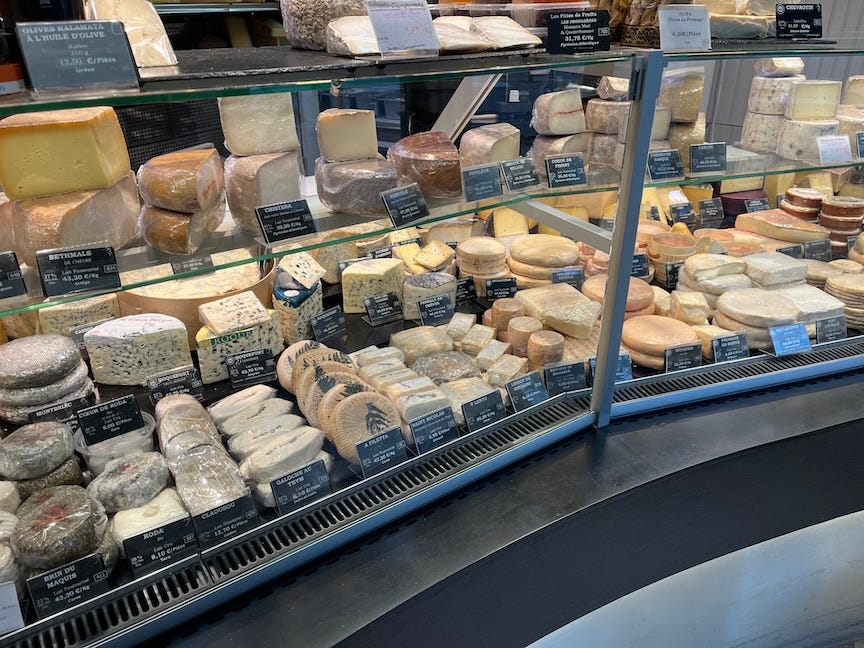
Charles de Gaulle famously mused about the challenge of running a country that makes 246 kinds of cheese. Turns out that number was an undercount — and by a wide margin. In addition to all the Camemberts and Comtés and Roqueforts, there are scads of Picodons and Sainte-Maures, Bries and Morbiers, Reblochons, Saint-Nectaires and Époisses. Throw a stone anywhere in France, and it’s likely to bounce off the heads of several cheesemakers. Estimates suggest there are over a thousand varieties of the stuff.
Contrariwise, setting aside imitations of foreign cheese, Americans are pretty much limited to Velveeta, Whiz, and the goo you find on burgers at McDonald’s.
The blandest and most popular cheese on our supermarket shelves is the one made from gobs of others mushed together into sameness. Check the label. It’s called “American.”
It’s weird. After all, the US is seventeen times larger than France, with five times the population. We should be smacking them down in the cheese department. And according to De Gaulle’s math, we ought to be five times as politically diverse. But it ain’t necessarily so.
Today’s question is: What can curds tell us about how a country is run?
Turns out, quite a bit.
Lactic politics
First off, the De Gaulle quip is funny because it’s true. Cheeses are plentiful in France, and they’re a sign of dogged territoriality. Try making a Camembert outside of Normandy or a Cantal anywhere but Auvergne, and you probably risk the guillotine (in which case you’re reading the wrong post, and you should go here instead.) A whole system of regulated branding makes sure people stay in their regional lane, helping the provinces maintain strong identities. Dairy products are just the tip of the cheeseberg.
The result is a surprising amount of regional independence simmering under the heavy lid of a centralized state. Take language, for instance. The French Revolution tried to stomp out local dialects, but even today you find schools where instruction is given in Basque, Breton, Catalan, Creole, Corsican, or Alsatian. Not as many languages as cheeses, but still. Whether you’re talking food, wine, education or economy, the regions mostly want to head in their own direction. They chafe at the restrictions handed down from Paris.
The cheese joke now translates into a broader question: How do you rule a bunch of people who would really rather be on their own?
The US and France have each wrestled with this topic. And their answers couldn’t be farther apart.
1: Get rid of all the damned cheeses
This is the American whey.
Think about it. The US used to be the patchwork country, the tapestry, the salad bowl, the gumbo nation, the smorgasbord, one land formed from many — e pluribus unum. But there is no bouquet of identities anymore. Culture has been homogenized. We may never have had 246 political flavors in the US, but now we’re down to just two.
Sure, you can still find a few Texans who want to secede, and New Yorkers remain, well, “special.” But otherwise, all the regional, racial, ethnic, and religious differences have been strained into two categories: those who are fer the way things are today and those who’re agin’ ‘em. It’s the Dems versus the Republicans, the Blues versus the Reds, the Hatfields taking potshots at the McCoys. Our new motto should be e duobus unum — one nation formed from two.

American politics are not just polarized between the two parties, but also evenly split between them. In fact, having 435 members of Congress is just a waste of money these days. We could save a bundle by sending one from each side to haggle over policy in Washington, letting them settle any arguments with a coin toss. Which, when you think about it, would be less crazy than what we do now.
This is one answer to De Gaulle’s question: reduce the competition. Just having two parties or two cheeses certainly simplifies life. For one thing, you always know who your enemy is.
2: The stinkier, the merrier
The French government is structured a lot like ours, but the differences are important. For one thing, in France you’re not forced to choose between Cheddar and Velveeta — you get a whole platter to pick from. And each wedge is pretty different.
For instance, there are twelve different parties currently represented in the National Assembly (ranging from well-aged communists to moldy fascists), and nine in the French Senate. Not even all the ministers in Macron’s cabinet belong to the same party, and although the President himself has the good form to belong only to one, he’s also somehow the co-prince of Andorra. Go figure.
With so many parties, France isn’t in a Hatfield-and-McCoy situation. While the American system consists of two idiots screaming at one another, in France you get a whole pack of idiots. And since they’re all yelling different things at different people, every now and then something smart emerges.
The numbers game extends to representation. Although only a fraction the size of the US, with a smidgen of the population, France has twice as many states (the 101 départements). With 577 members in their version of the House of Representatives, they have a third more than we do in the US. If you adjusted it for population, you’d need three Trump ballrooms just to seat them all. In short, France is massively more democratic in its representation.
It even scales to the micro-level. Thanks to all its small towns, France has nearly 35,000 mayors — almost twice as many as the US. These officials play a role in vetting presidential candidates, with big cities having the same power as small villages. And no town is too small to count. The record-holder is La Rochefourchat, in the Drôme region (where Saint-Félicien cheese is produced). There, the sole inhabitant is both mayor and entire electorate. Rumor is, she won by a landslide.
Democracy doesn’t get much more direct than that.
So, how do you rule a country with 246 different identities? The French answer: You set up a government structure that forces you to smell them all.
The last morsel
Presidential elections in the US are usually a Hobson’s choice between two bad candidates. Of course, sometimes there’s an oddball third candidate, or even a gag fourth one, but everybody knows it’s going to end up a face-off. Compare that to France, where twelve contenders duked it out in the last presidential election. For next year’s electoral circus, they’re expecting up to fifteen.
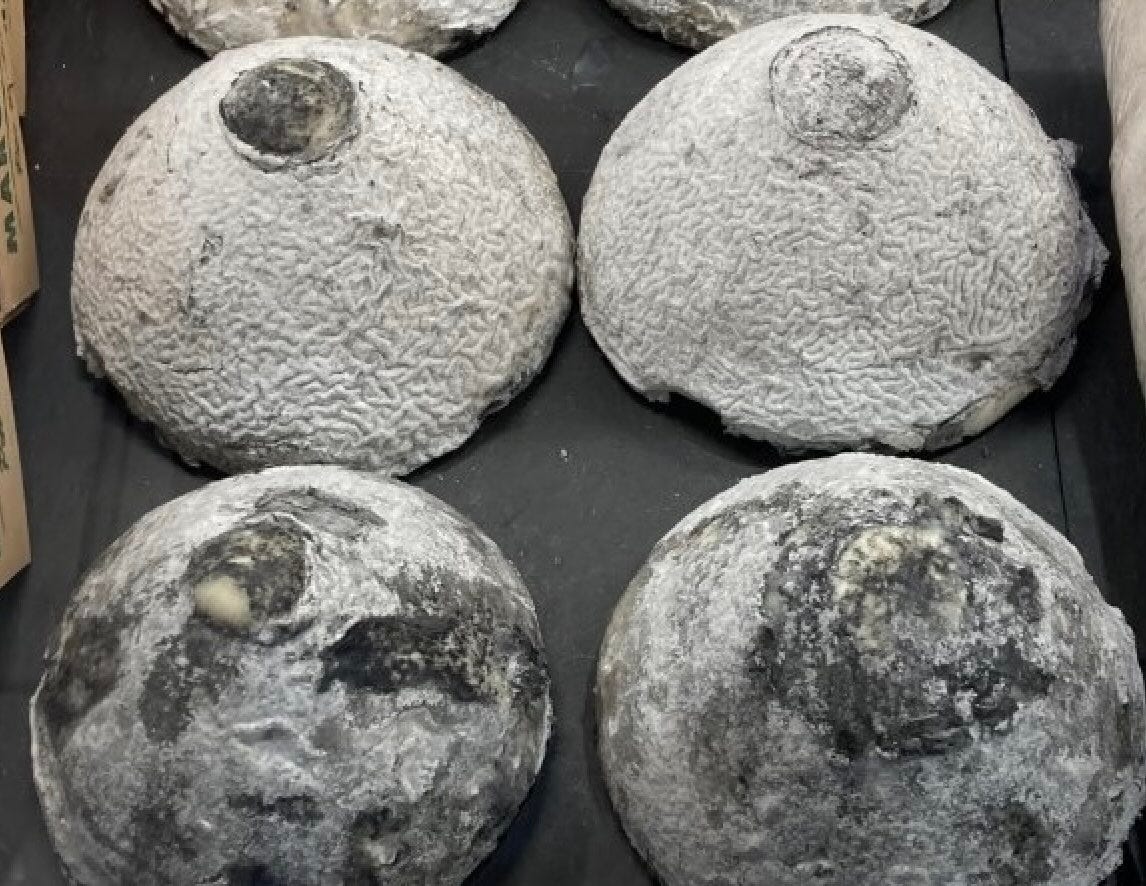
I can’t deny that 246 cheeses is a lot, and they come in different shapes and sizes. At my local fromagerie, there are wheels and pucks, wedges and pyramids, logs and — yes, honestly — ones called breasts. Some are hard and subtle, others liquid and pungent. You may hack them with a knife, garrot them with a wire, or eat them with a spoon. Plenty of them you’re never going to like. But they’re there, with their wonderful cacophony of aromas. And each one gets a spot on the cheese trolley.
Miss a recent post?
Ready, Fire, Aim! On firing squads, guillotines, and the spectacle of capital punishment.
A Pain in the Arc. Why France stopped building arches — and how Washington missed the memo.
The World’s a Mess. Pass the Shovel. Candide had it right — when everything’s falling apart, start with your own backyard.
Scott, you are correct, in several democratic countries inspired in the American model there are several political parties with different flavors. The USA is the only one with only two, I guess to differentiate it from the communist countries which have only one. Is it really better? Probably not. We need more ideas in a democracy to be representative and most importantly we need money out of politics!! which is almost impossible to imagine.
Just want to mention, I'm reading French Like Moi. All very enjoyable, but I particularly liked 'Underground Man.' I was only vaguely aware of the catacombs, and the reality of it all is fascinating.